

UX Design and Research for Education
Master of Industrial Design Thesis
Neurodiversity
An estimated 20% of the general population is neurodivergent, identifying with mental conditions considered atypical.1

How might we leverage neurodiversity to inspire new ways of learning within design projects?

Co-Design as Research
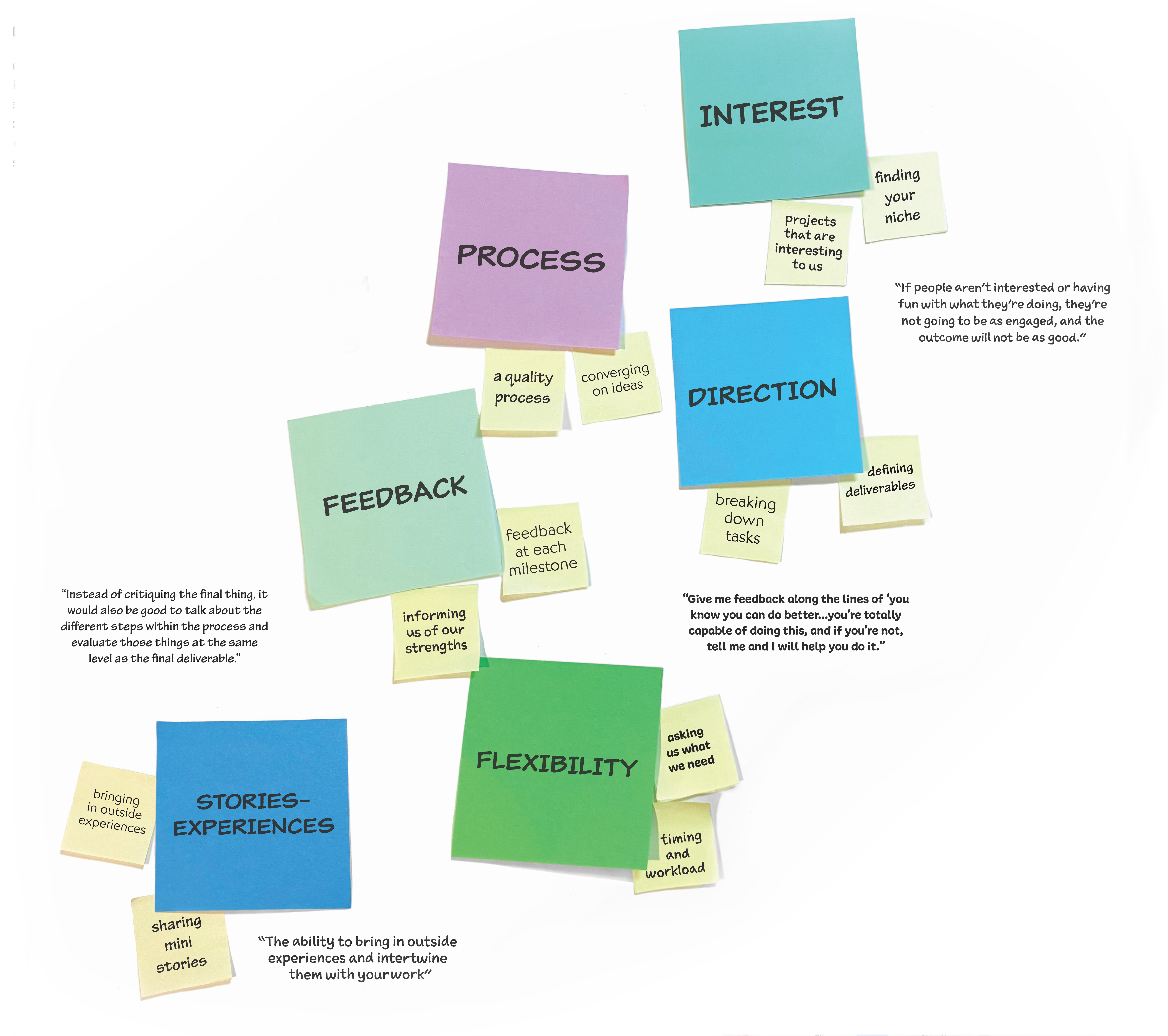
Seven designers identifying as neurodivergent participated in co-design sessions. We discussed the current state of design practice and reimagined its future.
For in-depth information, view the workshop format and thematic analysis process.
Brain Dump and Use of AI
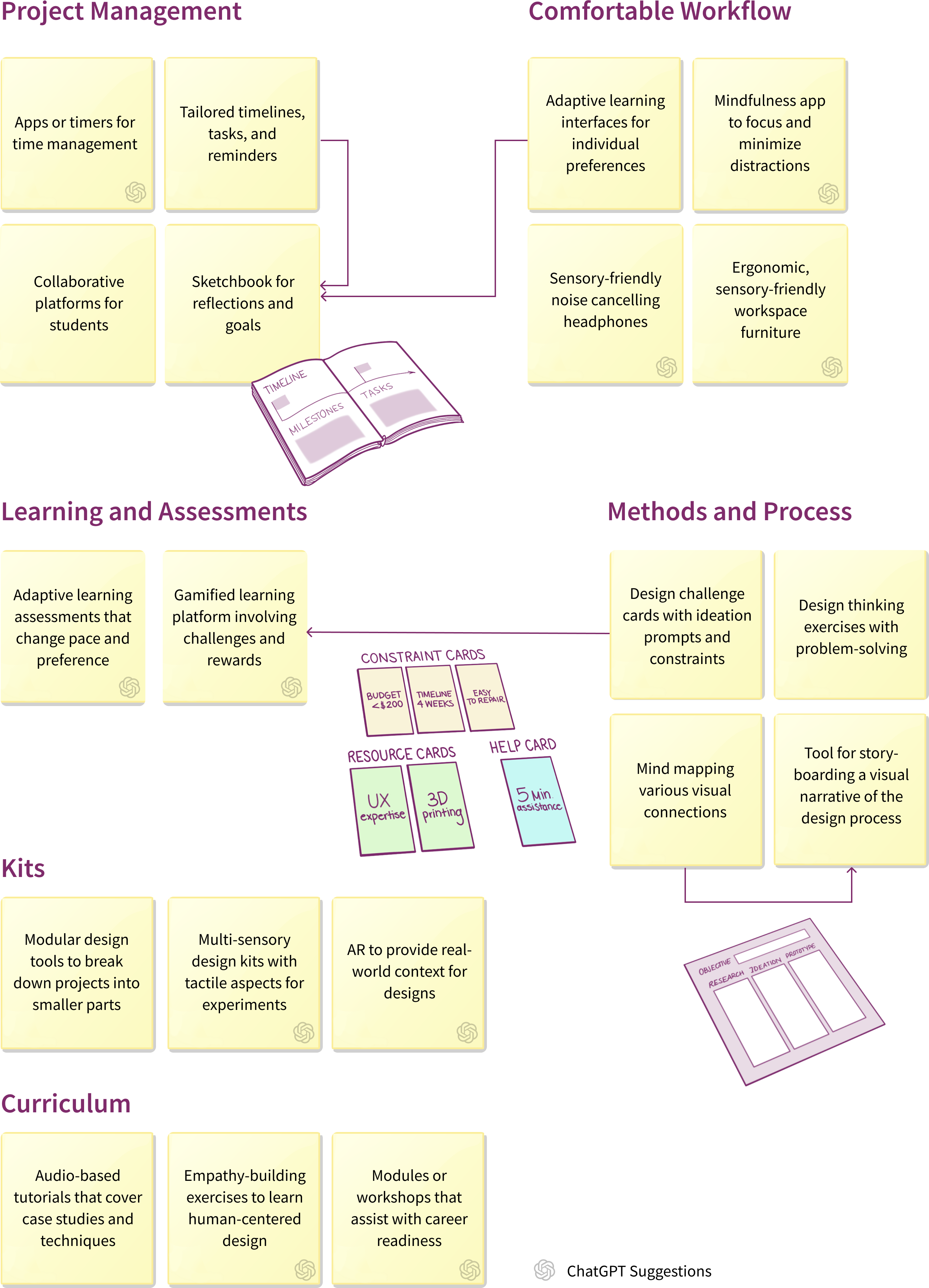
I broadened my potential scope by articulating 20 ideas, placed 6 categories. Since I had been influenced by the results of the co-design sessions, I asked ChatGPT to produce more ideas.
ChatGPT’s suggestions were shown to be based on neurodivergent diagnostic criteria, which differed from the co-designers’ suggestions, who mainly discussed empowerment and support in design projects.
3 Concepts and Expert Survey
The final 3 concepts were evaluated by 11 industrial design instructors via survey.
- Would you consider using this product in your studio?
- Provide comments on why you chose that answer.
“Project”
Customized sketchbooks based on a digital template

Top Desired Components:
Task Breakdown and Goal Setting
“It can be useful but it should be very easy to be customized based on the faculty and studio project.”
“It seems like there are students that need more help with time management and breaking down their tasks into small chunks.”

“Game”
Design sprint challenge with “Constraint cards,” “Resource Cards,” and “Help Cards”
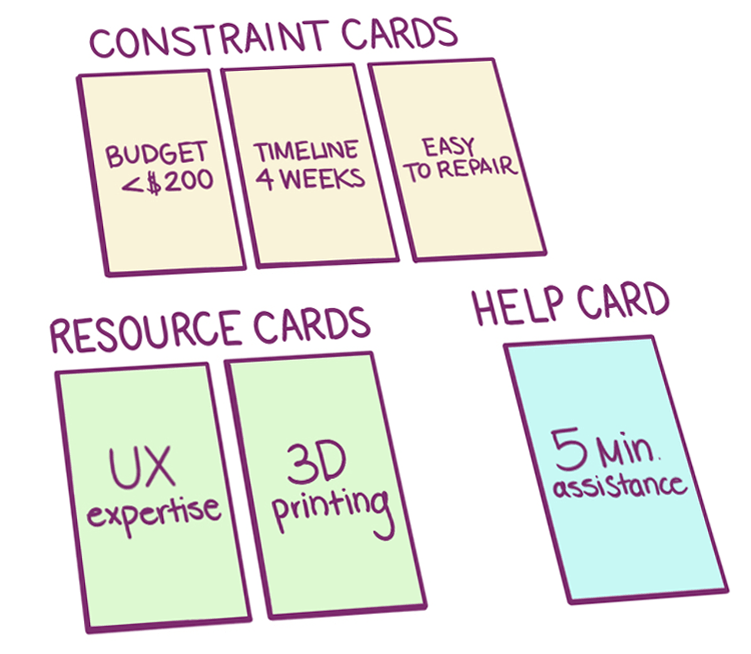
Top Desired Components:
Challenges and Rewards
“It might be good for a session in one lecture course but I am not sure how the result can be long lasting for students.”
“Depending on the theme and level of the studio”

“Story”
Medium for storyboarding and mind mapping a visual narrative of their design process
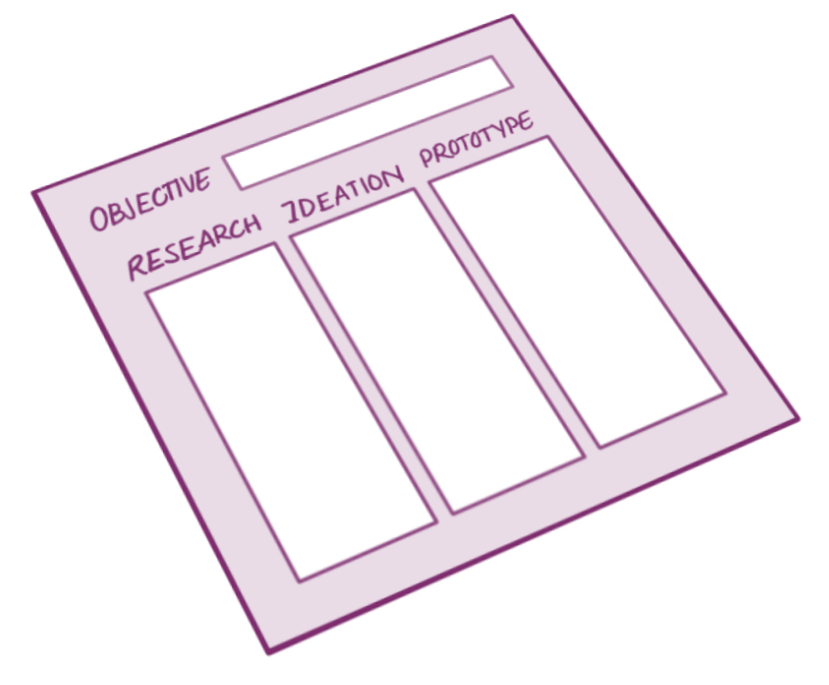
Top Desired Components: Communication, Presentation, and Sketching
“This is always challenging and less emphasis is placed on the narrative. This sounds great.”
“Storyboarding is a great skill – this may help improving it.”

Final
I considered the evaluations from the survey respondents and collaborated with a studio instructor for the final design and implementation, which was a combination of “Project” and “Story,” encompassing both project management and storytelling.
As a form of “narrative note-taking,” Naranote is a digital template that facilitates storytelling within design projects. See the Figma template for further detail and instructions.

Case Study with a Student
User Testing with Naranote
Naranote was also implemented within a junior-level studio and portfolio workshop.
Junior-level Studio Project
The juniors liked looking at their process holistically and separating their thoughts into “clear chunks.” However, completing Naranote during an intensive studio project was another task to complete and the 3 groups did not fully utilize the template.
“It was nice that it kept all the information in one place for us to look at after we added it in.”
“Since we mostly filled it in after the fact, it felt like we were narrowing down the things we already narrowed down to. We do think, however, that this template would be extremely helpful if it was used in a class where there was minimal structure and we had to figure out stages on our own.”

Portfolio Workshop
Naranote was better suited within a portfolio workshop, where I was actively available to provide guidance and they had dedicated time to complete the template in one session.
“I liked how easy it was to follow the template and write out my individual process of going through things.”
“I liked the way it brought attention to all steps of the process and the changes made along the way, instead of focusing only on the final product.”

Recognition
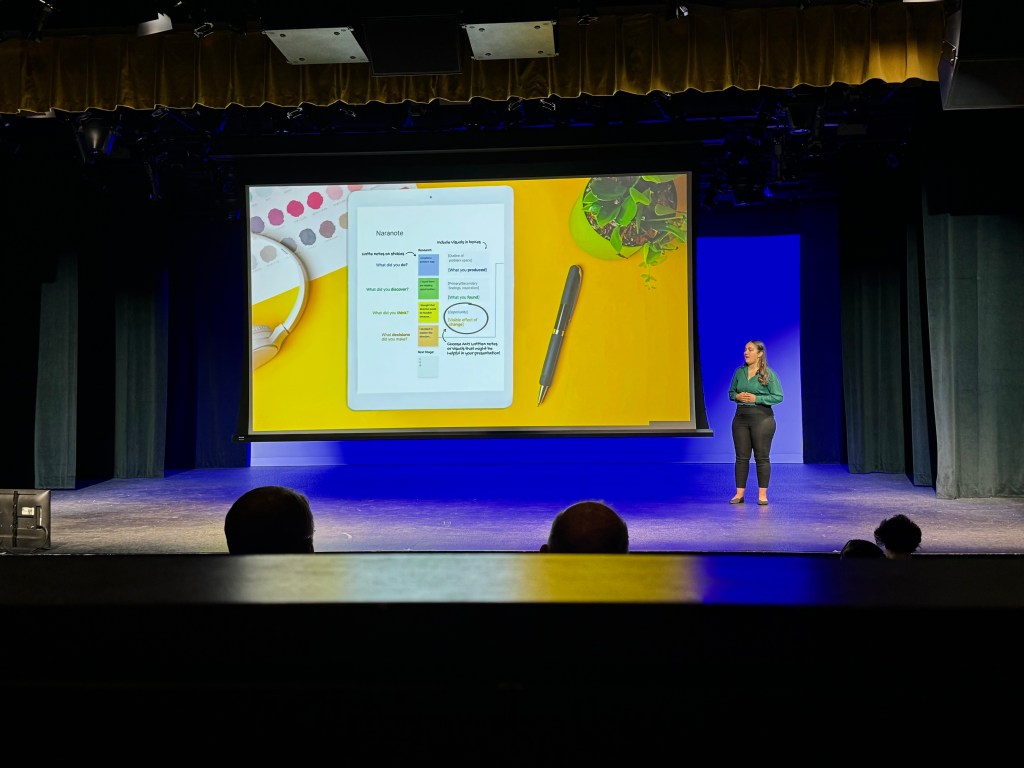
I was recognized for my thesis project as the “Master’s Winner” of the Georgia Tech 3 Minute Thesis Competition, challenging graduate students to explain their thesis in 3 minutes or less to a panel of non-specialist communication experts.
My master’s thesis was successfully defended in mid-April 2024 and is currently published in the Georgia Tech Library.
Takeaways
Since my thesis lasted an academic year, it tested my diligence and persistence. I planned and committed to personal deadlines to make incremental progress.
Distilling my work into a 3-minute pitch made me critically consider the most important findings and impacts of my work to tell a compelling story.
Special thanks to my Georgia Tech faculty committee (Sabir Khan, Dr. Leila Aflatoony, and Wayne Li) for their assistance with this project. Source: 1NIH (2022)

 Karina Bhattacharya